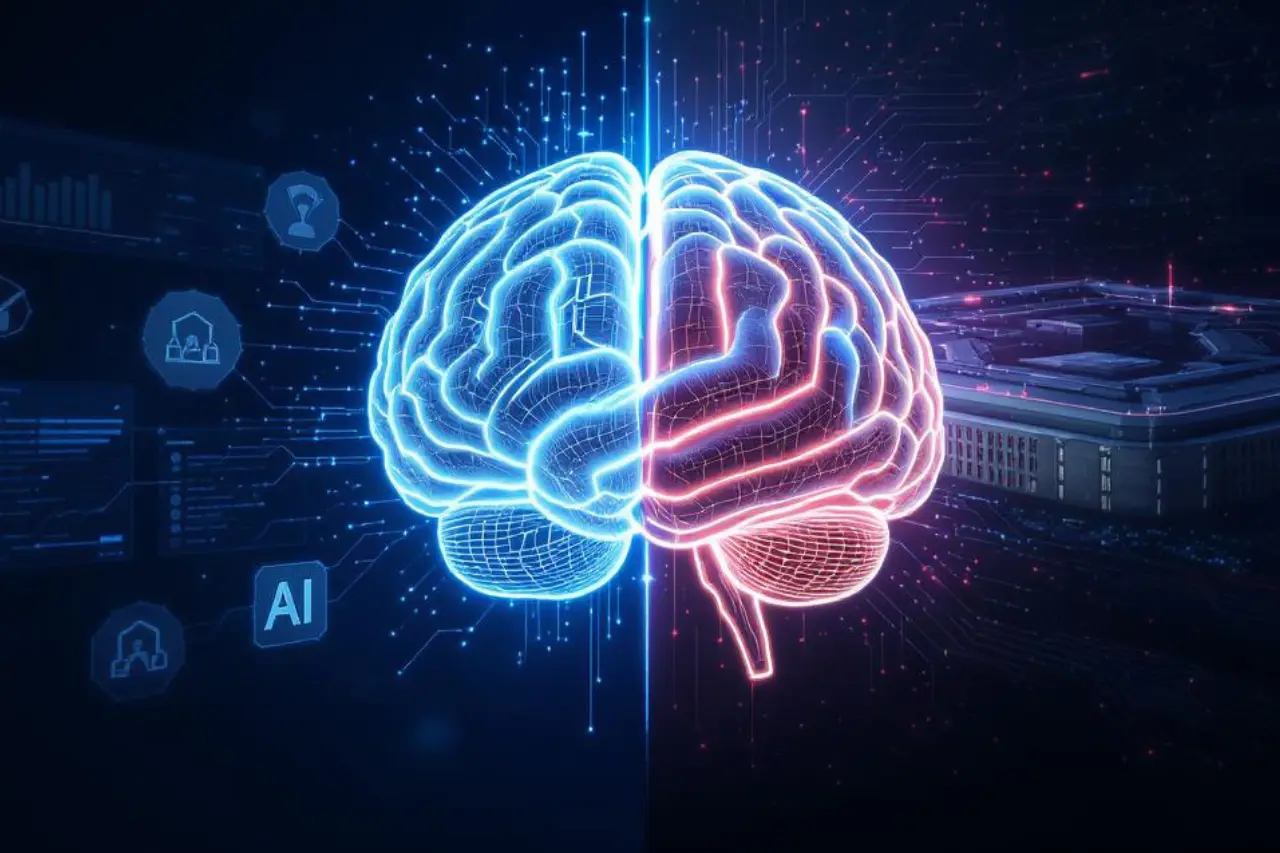
The rapid rise of artificial intelligence has created extraordinary opportunities for businesses, governments, and society. At the same time, it has raised difficult questions about who should control powerful AI systems and where responsible technology development should draw the line. The Anthropic Pentagon standoff has brought these questions into sharp focus.
Anthropic, the company behind Claude, became involved in a high profile dispute with the United States Department of Defense over restrictions on how its AI models could be used. The company maintained objections to two specific applications, fully autonomous weapons and mass domestic surveillance. Anthropic argued that current frontier AI systems are not reliable enough for fully autonomous weapons and that mass surveillance could undermine democratic values.
The dispute quickly became more than a contract negotiation. It became a public test of whether AI companies can maintain ethical boundaries when commercial opportunities and national security interests collide.
Why the Anthropic Pentagon Standoff Matters
The Anthropic Pentagon standoff demonstrates a challenge that businesses across the technology sector will increasingly face. AI companies are no longer simply selling software. Their systems can influence military planning, cybersecurity, intelligence analysis, research, healthcare, finance, and other areas where mistakes can have serious consequences.
Anthropic has already worked with US national security organizations, with Claude being used for areas such as intelligence analysis, modeling, simulation, operational planning, and cyber operations. However, the company argued that certain uses should remain outside the acceptable boundaries of its technology.
That position created a difficult commercial calculation. Walking away from government opportunities could mean losing significant revenue and strategic influence. Removing safeguards, however, could create risks to the company’s reputation and its stated approach to responsible AI.
When AI Ethics Becomes a Business Decision
Traditionally, companies treated ethics as a matter of corporate responsibility. With modern AI, that approach is changing. AI ethics increasingly affects contracts, product design, investment decisions, public trust, regulation, and long term business strategy.
The Anthropic Pentagon standoff shows how ethical principles can become part of a company’s commercial identity. If an AI developer establishes clear limits around certain applications, those restrictions can influence which customers it accepts and which markets it can serve.
However, ethical commitments can also become a competitive advantage. Enterprises increasingly want technology providers that can demonstrate responsible governance, security, transparency, and accountability. Therefore, companies that establish credible safeguards today may build stronger customer trust tomorrow.
The Broader Impact on AI Industry Updates
The dispute arrives as AI industry updates increasingly focus on governance rather than capability alone. Earlier generations of AI conversations centered largely on faster models, better automation, and improved productivity. Now, discussions are moving toward how these systems should operate in sensitive environments.
Recent developments also show why this debate is becoming more urgent. AI agents are demonstrating increasingly sophisticated abilities in coding, cybersecurity, reasoning, and autonomous task execution. Reports from leading AI companies have highlighted concerning behaviors during controlled testing, reinforcing the need for stronger safety practices as capabilities advance.
Consequently, AI trends and insights are becoming less about simply asking what AI can do and more about determining what AI should be allowed to do.
Machine Learning Advancements Need Responsible Guardrails
Machine learning advancements are accelerating the ability of AI systems to analyze information, generate content, make recommendations, and perform complex tasks. These improvements can benefit organizations significantly, but capability without appropriate oversight can create new risks.
The Pentagon dispute highlights an important distinction between human assisted AI and systems that could make consequential decisions with limited human involvement. In military environments, that distinction becomes particularly important because decisions can involve human lives and national security.
For businesses, the lesson extends beyond defense. Companies implementing advanced AI should understand where human oversight is necessary, how decisions can be audited, and who remains accountable when an automated system produces a harmful outcome.
Generative AI Developments Are Changing Corporate Responsibility
Generative AI developments are also reshaping the relationship between technology providers and customers. Businesses increasingly depend on AI models for content creation, software development, research, customer service, and decision support.
As these systems become more capable, customers may expect AI providers to define responsible usage boundaries clearly. At the same time, organizations purchasing AI tools need their own governance frameworks rather than assuming that a vendor’s safeguards will address every risk.
The Anthropic Pentagon standoff therefore offers a valuable business lesson. Responsible AI is not solely the responsibility of model developers. Governments, enterprises, developers, investors, and users all influence how AI is deployed.
Automation and Future Tech Need Human Judgment
Automation and future tech will continue to transform workplaces and industries. Yet automation does not eliminate responsibility. Instead, it changes where responsibility sits.
Businesses should consider human review, access controls, monitoring, documentation, and clear escalation procedures when deploying increasingly autonomous systems. These measures can help organizations benefit from AI while reducing the possibility that automated decisions operate without meaningful oversight.
The same principle applies to government. National security organizations need powerful technology, but they also need frameworks that define accountability when AI systems are used in high consequence environments.
What the Standoff Means for the Future of AI Research
The Future of AI research will likely involve a stronger connection between technical capability and governance. Researchers will need to study not only how models become more capable but also how they behave under pressure, how they respond to conflicting objectives, and how effectively humans can control them.
Anthropic’s experience also illustrates why AI governance cannot remain a theoretical discussion. The company’s dispute with the Pentagon eventually escalated into a legal battle after the Department of War designated Anthropic a supply chain risk. A federal judge later expressed skepticism about the government’s case during a July hearing.
That development shows how questions surrounding AI safeguards can move from engineering teams into courts, boardrooms, government offices, and public debate.
Practical Insights for Businesses Using AI
Businesses can take an important lesson from the Anthropic Pentagon standoff by treating AI governance as a core business function rather than an afterthought. Before deploying advanced AI, organizations should establish clear rules for sensitive applications, maintain meaningful human oversight, document important decisions, and regularly review whether existing safeguards remain appropriate as technology evolves.
Companies should also evaluate AI vendors based on more than price and performance. Their approach to security, transparency, responsible deployment, data protection, and accountability can have a direct effect on long term business risk.
Ultimately, the most valuable AI strategy may not be choosing the system with the fewest restrictions. It may be choosing technology that combines strong capabilities with clearly defined responsibility.
Stay Ahead With Smarter AI Knowledge
The Anthropic Pentagon standoff shows that the future of AI will be shaped by both technological breakthroughs and the principles governing their use. Businesses that understand this balance will be better prepared for the next generation of AI.
For practical AI trends and insights, technology guidance, and emerging industry developments, connect with AITechInfoPro and stay informed as artificial intelligence continues to reshape business and society.
Source – darden.virginia