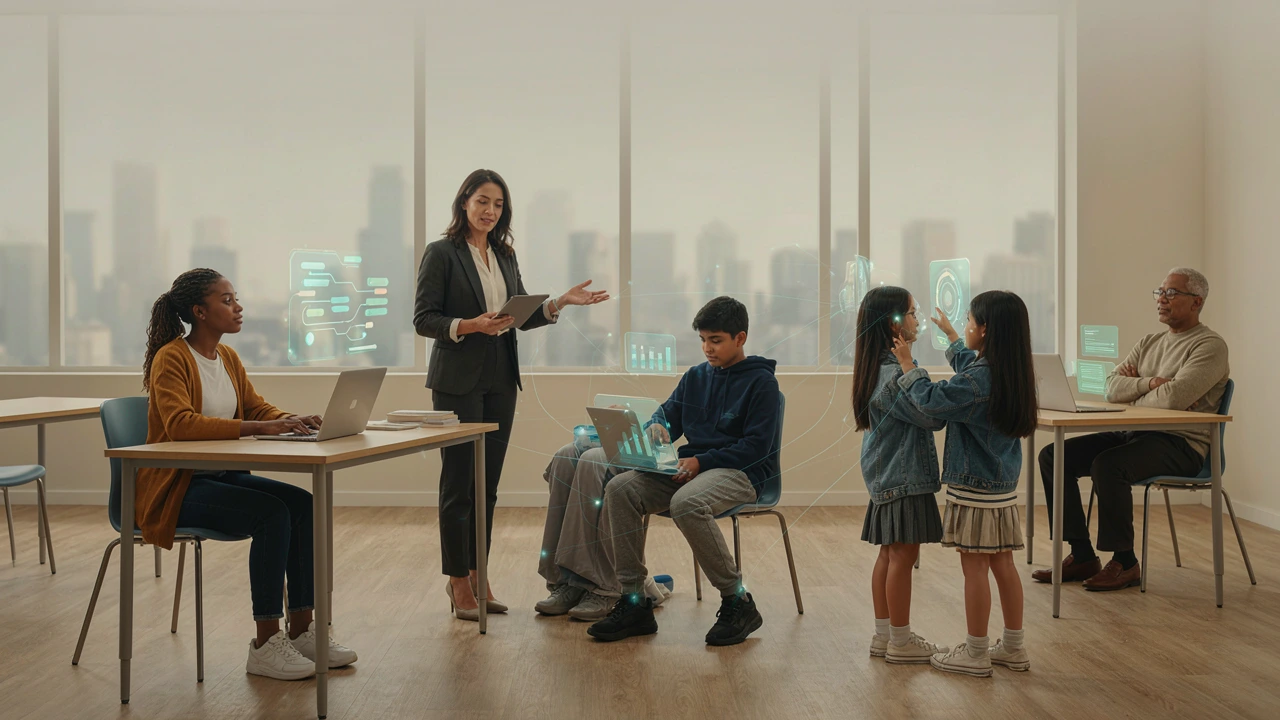
Education is becoming increasingly personalized as artificial intelligence changes how people learn, practice, and develop new skills. AI in adaptive education enables digital learning platforms to understand individual progress and adjust educational experiences based on each learner’s needs.
Traditional learning environments often provide the same content and pace to everyone. However, learners do not absorb information in exactly the same way. Some may need additional explanations, while others may be ready for more advanced material. AI can help bridge this gap by analyzing learning behavior and delivering content that responds to individual performance.
As a result, personalized education is moving from an emerging concept toward a practical application of modern technology.
How AI Enables Personalized Learning
The foundation of AI in adaptive education is data driven personalization. Intelligent systems can analyze assessment results, learning speed, interaction patterns, and previous performance to identify areas that require attention.
For instance, when a learner repeatedly struggles with a particular concept, an adaptive platform can recommend additional exercises or simpler explanations. Conversely, when someone demonstrates strong understanding, the system can introduce more challenging material.
Furthermore, machine learning models can become increasingly useful as they process more learning data. These machine learning advancements allow educational platforms to identify patterns that may not be immediately visible to teachers or trainers.
Intelligent Content Adaptation
One of the most valuable capabilities of adaptive education is the ability to modify content dynamically. Instead of following a fixed curriculum from beginning to end, learners can receive material according to their current level of understanding.
AI can recommend videos, articles, simulations, assessments, and interactive exercises that match individual learning requirements. Consequently, learners spend less time reviewing concepts they already understand and more time addressing genuine knowledge gaps.
This approach can also make learning more engaging because educational content becomes more relevant to the individual. Over time, personalized recommendations can create a learning journey that feels responsive rather than repetitive.
Generative AI and Learning Support
The growth of generative AI developments is adding another dimension to personalized education. Generative AI can help create explanations, practice questions, examples, summaries, and interactive learning conversations based on a learner’s needs.
For example, a student who finds a technical explanation difficult could request a simpler version or a practical example. Similarly, an employee learning a new technology could receive scenario based exercises that reflect their professional responsibilities.
However, effective implementation requires human oversight. AI generated educational material should be reviewed for accuracy, relevance, bias, and age appropriateness. Therefore, educators remain essential even as intelligent technologies expand their capabilities.
AI Powered Feedback and Assessment
Feedback plays a critical role in effective learning. Yet traditional assessments often provide results without explaining how learners can improve. AI can make feedback more immediate and personalized.
Adaptive assessment systems can evaluate responses and determine which concepts require additional practice. Moreover, they can adjust subsequent questions according to performance, creating a more responsive evaluation process.
This capability is particularly valuable in professional training. Organizations can use AI to understand employee skill gaps and recommend relevant development activities. In turn, this supports broader AI trends and insights around skills based learning and continuous professional development.
AI in Corporate Learning
The potential of AI in adaptive education extends well beyond schools. Companies are increasingly exploring intelligent learning systems to support employee development, reskilling, and knowledge management.
As technology changes job responsibilities, organizations need flexible ways to help employees acquire new capabilities. Adaptive platforms can recommend learning paths based on existing skills, career objectives, and business requirements.
This connection between education and workplace development also reflects broader automation and future tech trends. As routine activities become increasingly automated, continuous learning can help employees prepare for roles that require creativity, critical thinking, communication, and technological expertise.
Benefits for Educators and Organizations
Adaptive learning does not have to replace teachers or trainers. Instead, it can give them additional information about how learners are progressing.
For example, educators can identify common areas of difficulty and provide targeted support. Meanwhile, organizations can use aggregated learning insights to improve training programs and allocate development resources more effectively.
Additionally, personalized systems can make learning more accessible. Learners who need additional time or alternative explanations can receive support without necessarily slowing down everyone else.
Challenges of AI Based Adaptive Education
Despite its potential, AI in adaptive education also presents important challenges. Learning platforms depend heavily on data, which means privacy and security must be treated as priorities. Organizations should clearly explain how learner information is collected, stored, and used.
Algorithmic bias is another concern. If an AI system is trained on incomplete or unbalanced data, its recommendations may not serve every learner fairly. Therefore, regular evaluation and human oversight are essential.
There is also a risk of excessive dependence on technology. Education involves motivation, empathy, creativity, and social interaction. AI can support these elements, but it cannot fully replace meaningful human relationships.
The Future of AI in Education
The direction of AI in adaptive education will increasingly be influenced by developments across the wider technology landscape. More sophisticated models could enable learning systems to understand context, identify changing skill requirements, and deliver increasingly precise recommendations.
At the same time, AI industry updates continue to demonstrate how rapidly intelligent technologies are evolving. Advances in multimodal AI, conversational systems, predictive analytics, and personalized interfaces could create richer learning environments.
Looking ahead, future of AI research is likely to explore how intelligent systems can make education more inclusive, measurable, flexible, and responsive while maintaining strong ethical standards.
Valuable Insights for Technology and Education Leaders
Organizations exploring adaptive learning should begin with a clear educational or business objective. Technology works best when it addresses a specific learning challenge rather than being introduced simply because AI is becoming popular.
Leaders should also evaluate learning outcomes instead of focusing only on platform usage. Skill improvement, learner engagement, knowledge retention, and practical performance provide stronger indicators of success.
Most importantly, organizations should maintain a human centered approach. The strongest adaptive learning environments will combine intelligent technology with expert educators, high quality content, responsible data practices, and continuous evaluation.
Connect With AITechInfoPro
Stay informed about emerging artificial intelligence technologies and the ideas shaping tomorrow’s digital world with AITechInfoPro.
Reach out to AITechInfoPro for valuable technology perspectives that can help you understand and navigate the rapidly evolving AI landscape.