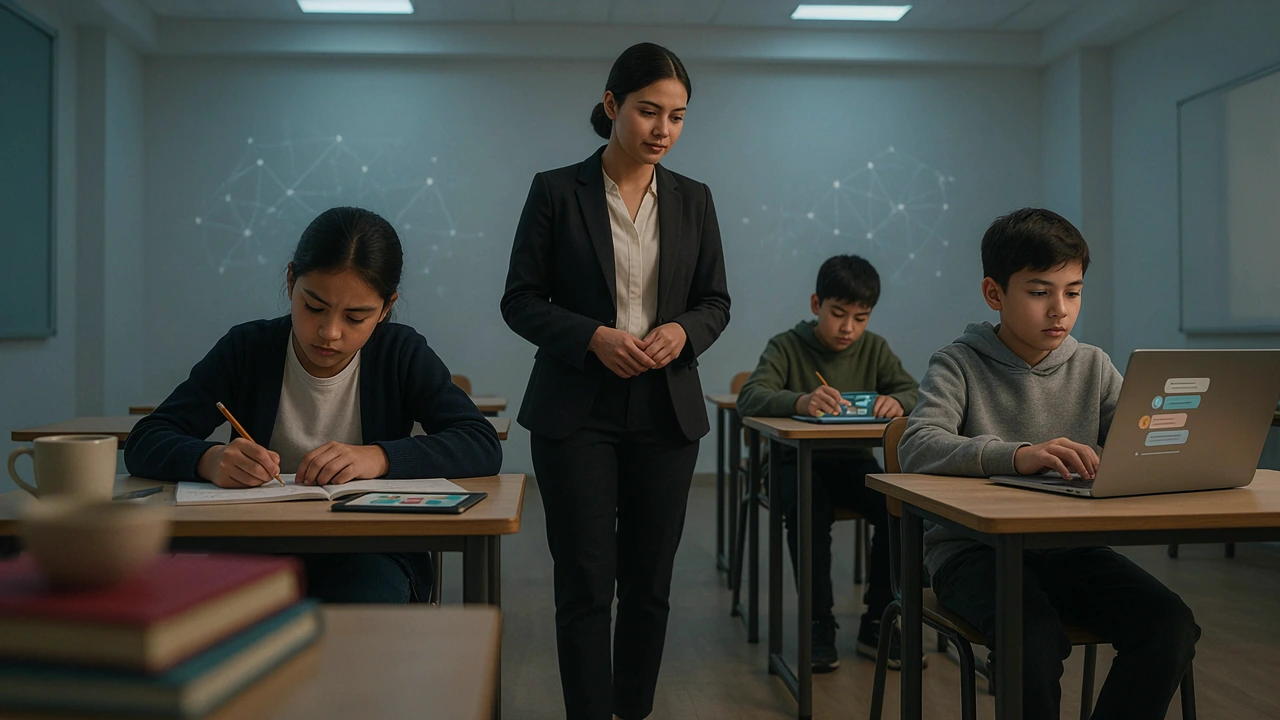
Artificial intelligence is rapidly becoming part of everyday education. From answering questions to helping students write essays, solve problems and research topics, AI tools are making learning faster and more accessible. However, growing dependence on these systems is also raising concerns about how technology may influence pupils’ thinking skills.
Recent survey findings suggest that some students may be relying heavily on AI when completing academic work. While artificial intelligence can support education when used responsibly, excessive dependence could reduce opportunities for students to think independently, evaluate information and develop their own ideas.
This issue is becoming increasingly relevant as AI trends and insights continue to shape classrooms and educational technology.
Why Pupils’ Thinking Skills Matter
Thinking skills are central to effective learning. Students need to understand information, question assumptions, compare different ideas and develop solutions independently. These abilities cannot simply be replaced by receiving a ready made answer from an AI system.
When pupils regularly attempt problems themselves, they strengthen reasoning and analytical abilities. They also learn how to deal with uncertainty and mistakes. Therefore, if AI consistently performs these mental tasks for them, there is a possibility that some important learning opportunities could be reduced.
The concern is not necessarily about using AI itself. Instead, the focus is on how students use it and whether technology becomes a learning assistant or a substitute for genuine intellectual effort.
Generative AI Is Reshaping Education
Generative AI developments have created powerful tools capable of producing essays, summaries, explanations, images and computer code within seconds. For students, this can be extremely useful. A learner struggling with a difficult concept can ask an AI system for another explanation or request examples that make the subject easier to understand.
However, convenience can create a new educational challenge. If students copy generated answers without examining the reasoning behind them, they may complete assignments without developing a strong understanding of the subject.
Consequently, educators are beginning to consider how assignments and classroom activities should change. Rather than simply banning AI, schools may need to teach students how to question, verify and improve AI generated information.
The Risk of Over Reliance on AI
The relationship between technology and learning has always involved tradeoffs. Calculators reduced the need for manual calculations, search engines changed research habits and digital dictionaries made language reference almost instant. AI could have an even deeper effect because it can perform tasks that previously required significant human reasoning.
For pupils, the biggest risk may emerge when convenience replaces curiosity. Instead of asking why an answer is correct, a student might simply accept the response produced by an AI tool. Over time, that habit could influence critical thinking, creativity and independent problem solving.
Machine learning advancements are making AI systems increasingly capable of understanding context and generating convincing responses. As these systems become more sophisticated, students may find it even harder to recognize when they should challenge an answer rather than accept it.
AI Can Still Support Better Learning
Despite these concerns, AI should not be viewed only as a threat to education. Used correctly, it can become a valuable learning partner. Students can ask AI to explain difficult concepts, generate practice questions, provide feedback on drafts or present alternative perspectives.
The key difference is whether the student remains intellectually involved.
For example, instead of asking AI to write an entire assignment, students can use it to identify weaknesses in their own draft. They can then evaluate the suggestions and decide which changes make sense. This approach encourages active participation while still benefiting from technology.
Similarly, teachers can use AI to create personalized exercises and learning materials. This could help educators provide additional support to students who need more practice while allowing advanced learners to explore challenging concepts.
What Schools Need to Consider
Education systems now face the challenge of balancing innovation with intellectual development. Schools need clear guidance around responsible AI use while giving students opportunities to develop skills without technological assistance.
Assessment methods may also need to evolve. More classroom discussions, presentations, practical activities and supervised writing could help teachers understand how well students actually comprehend a subject.
Furthermore, digital literacy should become an important part of modern education. Students need to understand that AI systems can produce incorrect, incomplete or biased information. Learning how to verify AI responses is therefore becoming as important as learning how to use AI itself.
These changes reflect wider automation and future tech developments, where human judgment will remain important even as intelligent systems become more capable.
The Bigger Picture for Future AI Research
The education debate is part of a much larger conversation about the future of artificial intelligence. Researchers are increasingly examining how AI affects human behavior, decision making, creativity and learning.
Future of AI research could therefore focus not only on making systems more intelligent but also on understanding how humans interact with them. This distinction will become increasingly important as AI becomes embedded in schools, workplaces and everyday services.
At the same time, AI industry updates continue to show rapid progress across generative systems, machine learning and automated applications. As adoption expands, society will need stronger frameworks for ensuring that technology enhances human abilities rather than unnecessarily replacing them.
Practical Lessons for Students and Educators
The most useful approach is to treat AI as a tool for learning rather than a shortcut around learning. Students can first attempt a problem independently and then use AI to check their reasoning. They can compare AI responses with textbooks and trusted sources, identify mistakes and explain concepts in their own words.
Teachers can also design activities that require students to demonstrate their reasoning. Asking learners to explain how they reached an answer can reveal much more than simply checking whether the final answer is correct.
Most importantly, students should continue practicing activities that require concentration, creativity and independent judgment. AI can provide assistance, but the ability to think critically remains a uniquely valuable human capability.
Insights for the Future of Education
The growing use of AI presents education with both an opportunity and a responsibility. Technology can personalize learning, improve accessibility and give students new ways to explore complex subjects. At the same time, excessive dependence could weaken the habits of questioning and independent reasoning that education is designed to develop.
The solution is not to reject AI but to build stronger AI literacy. Students who learn when to use artificial intelligence, when to question it and when to work without it will be better prepared for an increasingly automated world.
For more AI trends and insights, technology developments and expert perspectives, connect with AI Tech Info Pro.
Stay informed with practical coverage of emerging technology and the ideas shaping the future of artificial intelligence.
Source – theguardian