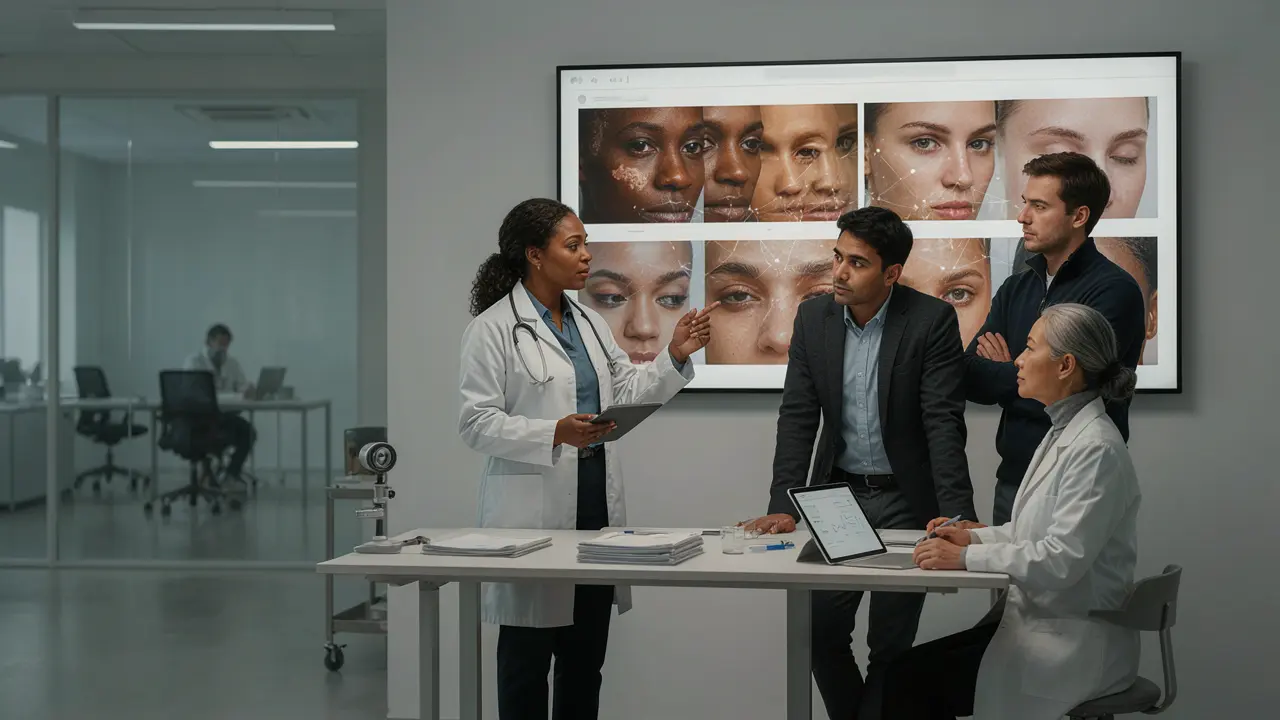
Artificial intelligence is changing healthcare, and dermatology is becoming an important area for machine learning applications. However, the effectiveness of these technologies depends heavily on the quality and diversity of the information used to train them. Training Physicians and Algorithms for Diverse Dermatology has therefore become an important focus for researchers seeking more reliable and inclusive diagnosis.
Dermatology has historically faced a representation gap in medical education. Textbooks, clinical resources and image databases have often contained fewer examples showing conditions on darker skin. As a result, physicians may have less exposure to how certain diseases appear across different skin tones. Stanford researchers have also found that dermatology algorithms trained predominantly on lighter skin images can perform less effectively when assessing darker skin.
The Importance of Diverse Dermatology Data
Medical AI systems learn patterns from their training data. Consequently, when a dataset lacks sufficient representation of different skin tones, an algorithm can develop performance gaps between patient groups.
Research involving the Diverse Dermatology Images dataset demonstrated that previously developed dermatology algorithms performed less effectively on images of Black and brown skin. Researchers also found that fine tuning algorithms with more diverse images could help reduce some of these performance differences.
This makes Training Physicians and Algorithms for DiverseDermatology more than a technology challenge. It is also an education and data quality challenge. Physicians need opportunities to recognize how conditions can present differently, while developers need representative datasets for building and testing AI systems.
How Machine Learning Can Support Better Diagnosis
Machine learning advancements are creating new opportunities for image based healthcare. Dermatology is particularly suitable for AI because many diagnostic decisions involve visual assessment of lesions, rashes, pigmentation and other changes.
However, accuracy alone does not provide a complete picture of an AI system. A model can achieve strong overall results while still producing different levels of performance across patient groups. A 2024 Nature Medicine study involving hundreds of physicians from multiple countries found differences in diagnostic accuracy across skin tones. The research also showed that fair deep learning assistance could improve physician accuracy while some performance disparities remained.
Therefore, Training Physicians and Algorithms for Diverse Dermatology requires evaluation across different populations rather than relying only on overall accuracy.
Building Better AI Training Datasets
More representative datasets can help researchers understand whether an algorithm performs consistently across different skin tones. The Diverse Dermatology Images dataset was created as a curated resource containing dermatology images representing a wider range of skin tones.
More recently, researchers have continued exploring technical approaches to reduce skin tone bias. A 2026 Scientific Reports study investigated a multimodal approach that combines conventional color images with structural sketches. The researchers reported reduced measured disparities across skin tone groups in their evaluated datasets, although they also noted that further clinical validation is needed to establish real world impact.
These developments reflect broader AI trends and insights around responsible model development. Instead of treating diversity as an additional feature, developers are increasingly considering it as an essential part of dataset design, testing and validation.
Preparing Physicians for AI Supported Dermatology
Technology alone cannot solve every challenge. Physicians also need education that reflects the diversity of real world patients. Training should expose medical professionals to conditions across a broad range of skin tones and help them understand where AI assistance can be useful.
This is particularly important because human and algorithmic errors can interact. Research has shown that physicians may benefit from AI decision support, but an AI system can also introduce or reinforce existing biases.
As a result, Training Physicians and Algorithms for Diverse Dermatology should involve collaboration between dermatologists, data scientists, medical educators and technology developers. Such collaboration can help ensure that clinical knowledge and computational methods develop together.
Generative AI and the Future of Dermatology
Generative AI developments are expanding the possibilities for healthcare education and decision support. Future systems could potentially assist physicians by organizing clinical information, explaining possible diagnoses and supporting educational simulations.
Nevertheless, these applications require careful validation. Recent research published in 2026 found that explanations generated alongside AI dermatology predictions can affect how people interpret algorithmic recommendations. The findings highlight the importance of designing systems that support human judgment rather than encouraging excessive reliance on automated answers.
Consequently, automation and future tech in dermatology should focus on improving clinical workflows while keeping qualified professionals involved in important diagnostic decisions.
What AI Industry Updates Mean for Healthcare
Current AI industry updates increasingly emphasize responsible development, fairness and performance across diverse populations. In dermatology, these priorities are particularly relevant because visual symptoms can vary significantly between skin tones.
Future systems will need broader validation, transparent performance reporting and continuous monitoring after deployment. Researchers are also examining how algorithms behave when they encounter data from different hospitals, devices and clinical environments.
For healthcare organizations, this means evaluating more than headline accuracy. A useful system should demonstrate dependable performance across the populations it is designed to serve.
Insights for the Future of Dermatology AI
Training Physicians and Algorithms for Diverse Dermatology highlights an important principle for the future of healthcare AI. Better technology begins with better representation, stronger clinical education and rigorous evaluation.
Organizations developing dermatology AI should prioritize diverse datasets, subgroup testing and collaboration between clinical experts and machine learning specialists. At the same time, physicians should receive training that reflects the full range of skin presentations encountered in clinical practice.
The Future of AI research will increasingly focus on creating systems that are not only accurate but also reliable across different populations and real world environments. When human expertise and AI development progress together, dermatology can move toward more inclusive and dependable digital healthcare.
For more insights into artificial intelligence, emerging technologies and responsible innovation, reach out to AI Tech Info Pro.
Stay informed about the latest developments shaping the future of AI and healthcare technology with AI Tech Info Pro.