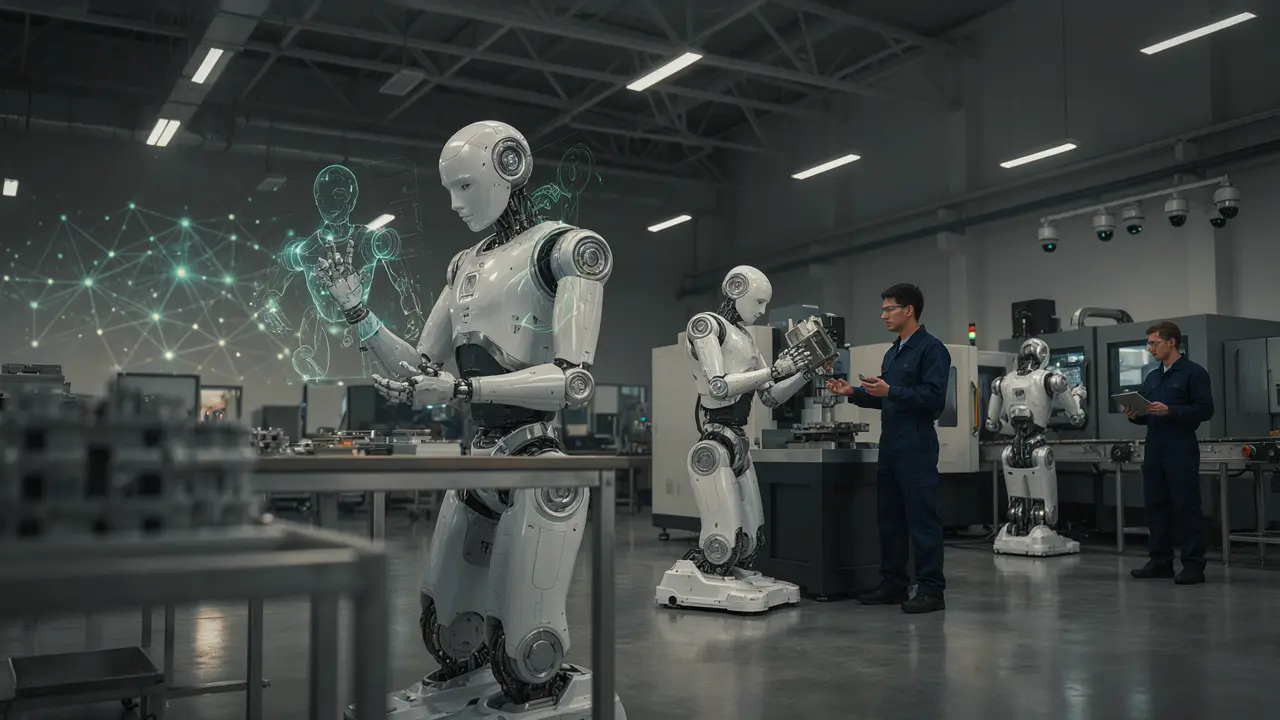
The race to develop useful humanoid robots is moving beyond impressive demonstrations and controlled laboratory environments. Increasingly, robotics companies are focusing on whether intelligent machines can perform meaningful tasks inside real factories, warehouses and service environments.
RLWRLD has positioned itself around this shift with a deployment first approach to physical AI. The company presented its strategy at Humanoids Summit Seoul 2026, where it emphasized industrial deployment, real world data and robotic dexterity as interconnected elements of its development model.
Rather than treating deployment as the final stage of development, RLWRLD is using real operational environments as part of the learning process. Consequently, the company aims to create a continuous connection between industrial operations, data collection and improvements to robotic intelligence.
Why Physical AI Needs Real World Experience
Traditional AI systems can often be trained using enormous collections of digital information. Physical AI faces a different challenge because robots must interact with objects, people and environments that behave differently from controlled simulations.
For a humanoid robot, recognizing an object is only part of the problem. The system must also determine how to grasp it, how much force to apply and how to respond when the object moves unexpectedly.
RLWRLD therefore places particular attention on dexterity. Its strategy focuses on teaching robots to perform complex manipulation tasks involving hands and fingers in environments where conditions can change continuously.
This approach reflects broader AI trends and insights showing that the next phase of intelligent machines will depend increasingly on the ability to connect perception, reasoning and physical action.
Dexterity Becomes a Key Robotics Challenge
Industrial automation has already transformed manufacturing by enabling machines to perform highly repetitive and precise operations. However, many tasks that require flexible manipulation remain difficult to automate.
Human workers can naturally adjust their grip, pressure and movement when handling unfamiliar objects. Robots, by comparison, often require carefully programmed instructions or task specific training.
RLWRLD is targeting this gap through its focus on dexterous manipulation and foundation models. The company’s RLDX model is designed to support different robotic embodiments, including industrial robots and humanoid systems.
As a result, the company’s strategy connects machine learning advancements with practical industrial requirements.
Real Industrial Data Drives Continuous Learning
One of the central ideas behind the approach is that real industrial environments can provide valuable training information that simulations may not fully reproduce.
Factories contain changing lighting conditions, different object shapes, unexpected movements and variations in production processes. By collecting data from actual operations, robotics developers can expose models to these conditions much earlier.
RLWRLD says its approach uses industrial data as a foundation for improving its models. Its business model also emphasizes long term partnerships in which data, models and operations can improve together over time.
Therefore, deployment becomes part of a feedback cycle rather than simply a commercial endpoint.
From Pilot Projects to Production
The difference between demonstrating a robot and operating one reliably in production is substantial. A successful demonstration may involve a controlled environment and a limited number of tasks. Industrial deployment requires consistency, safety, integration and operational support.
RLWRLD’s business approach focuses on moving from assessment to field validation and eventually toward broader deployment. The company identifies manufacturing, logistics, retail, hospitality, aviation and food operations among potential application areas.
This emphasis reflects a wider movement within automation and future tech toward systems that are measured by practical performance rather than demonstrations alone.
The Role of Foundation Models
Foundation models are becoming increasingly important in robotics because they can potentially allow one underlying intelligence system to support multiple tasks and robotic platforms.
RLWRLD’s RLDX model is designed to combine visual information with proprioceptive, tactile and torque sensing. According to AWS, the model is intended to support different robot configurations while focusing on dexterous manipulation.
This hardware agnostic approach could make robotic intelligence more adaptable. Instead of creating an entirely separate intelligence system for every machine, developers can potentially transfer learned capabilities across different platforms with additional training or fine tuning.
Industrial AI Moves Toward Practical Value
The growing interest in humanoid robots is happening alongside rapid developments throughout the robotics sector. Industry data reported by the International Federation of Robotics indicates that around 7,000 humanoid robots were sold globally in 2025 for industrial and professional service applications.
Although that number remains small compared with conventional industrial robot installations, it signals growing interest in humanoid systems for commercial environments.
Consequently, companies developing physical AI are increasingly being evaluated on their ability to move from research into dependable operational use.
Data and Infrastructure Will Shape Progress
Real world robotic intelligence requires more than sophisticated algorithms. It also depends on sensors, computing infrastructure, data storage and reliable connectivity.
RLWRLD has worked with AWS to train its robotics foundation models using large volumes of industrial data and substantial GPU resources. AWS reported that the company’s training infrastructure uses NVIDIA H200 GPUs along with distributed computing and high performance storage technologies.
This illustrates how machine learning advancements are becoming increasingly dependent on infrastructure capable of processing large amounts of physical world information.
What the Strategy Means for the Future of AI
RLWRLD’s deployment first approach represents a broader shift in the development of physical AI. Instead of waiting for models to become fully mature before entering industrial environments, developers can use carefully managed deployments to identify weaknesses and gather new information.
Over time, this could create a cycle in which better deployment generates better data, better data improves models and improved models support more capable robots.
Future of AI research is therefore likely to involve a closer relationship between laboratories and real operating environments. The boundary between research, product development and industrial deployment may become increasingly connected.
Businesses considering humanoid robotics should look beyond the appearance or mobility of a machine. The more important questions involve how well its intelligence generalizes, how easily it integrates with existing infrastructure and whether it can continuously improve from operational data.
Organizations should also evaluate the tasks they want to automate before selecting a robotic platform. Repetitive activities that require physical dexterity may offer different opportunities from highly standardized automation.
For technology leaders, following AI industry updates alongside machine learning advancements can provide a clearer understanding of where physical AI is moving and which capabilities are becoming commercially relevant.
For deeper AI trends and insights, automation developments and practical physical AI analysis, reach out to AI Tech Info Pro for informed technology perspectives.
Stay connected with AI Tech Info Pro to explore emerging robotics opportunities and the technologies shaping the future of intelligent automation.
Source – roboticsandautomationnews