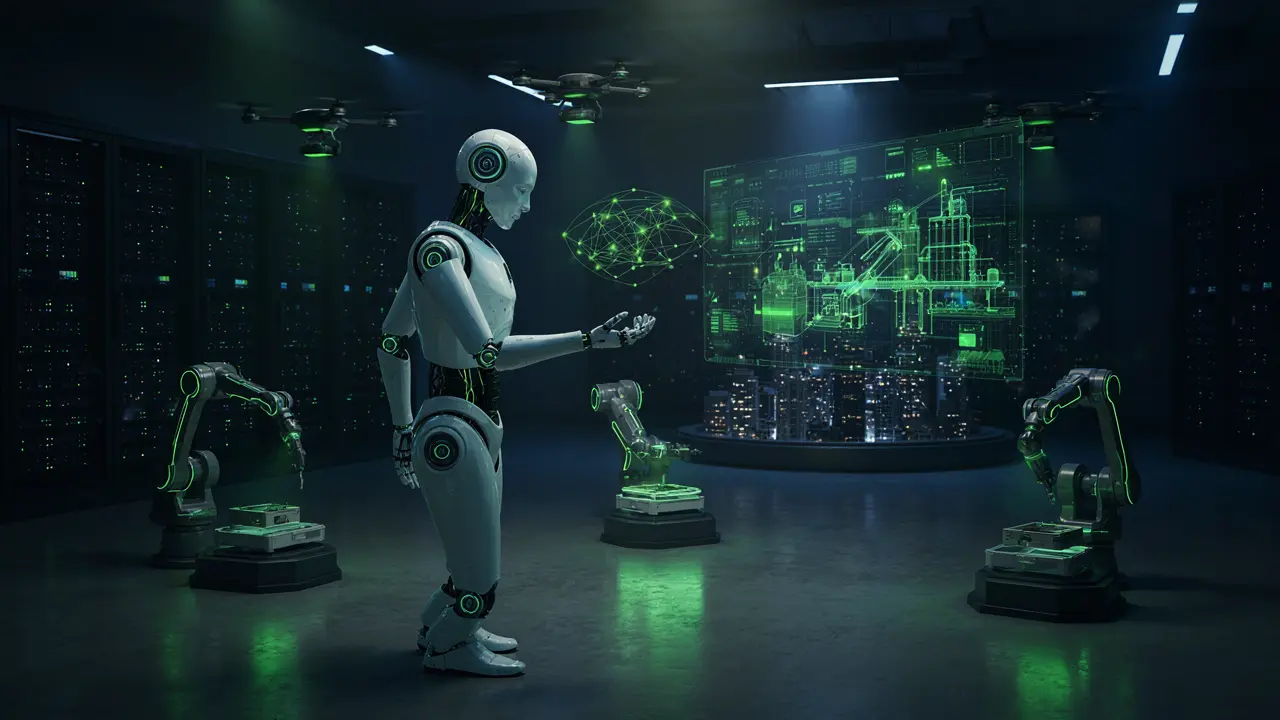
NVIDIA is strengthening the connection between artificial intelligence, advanced graphics and realistic simulation as businesses move toward a new era of intelligent machines. Its latest work around agentic physical AI highlights how AI systems can increasingly understand environments, make decisions and interact with the physical world.
Unlike conventional AI applications that mainly process information, agentic physical AI is designed to support systems that can perceive conditions, reason about possible actions and respond with greater autonomy. This approach is becoming increasingly important across robotics, industrial automation, autonomous systems and digital simulation.
As a result, NVIDIA is positioning its graphics and simulation technologies as an important foundation for organizations exploring the next generation of intelligent physical systems.
Why Graphics Matter for Physical AI
Realistic graphics are no longer limited to entertainment and visualization. Today, they play an important role in helping AI systems learn how real environments behave.
Through advanced rendering and simulation capabilities, developers can create virtual environments where intelligent machines can be trained and evaluated before operating in the physical world. This can reduce development risks while allowing teams to test numerous scenarios more efficiently.
Furthermore, highly detailed simulations can provide AI models with diverse training experiences. Robots, autonomous machines and other intelligent systems can encounter different environments, obstacles and operating conditions without requiring every situation to be recreated physically.
This shift reflects broader machine learning advancements that are making AI systems more capable of learning from complex and dynamic environments.
NVIDIA Connects Simulation With Intelligent Agents
The growing relationship between simulation and intelligent agents is particularly significant. AI agents need environments where they can observe conditions, make decisions and learn from outcomes. Simulation can provide that environment at scale.
NVIDIA technologies can help developers build virtual worlds that closely represent factories, warehouses, cities and other physical spaces. Within these environments, AI powered systems can explore different actions and understand how those actions could affect their surroundings.
Consequently, simulation becomes more than a development tool. It becomes part of the learning process for intelligent machines.
This development also connects with wider generative AI developments, where AI is increasingly being used to create content, environments and experiences that support sophisticated training and experimentation.
Supporting Robotics and Digital Twins
Robotics is one of the areas where agentic physical AI could have a significant impact. Modern robots need more than mechanical precision. They must increasingly understand context, respond to changing conditions and complete tasks with limited human intervention.
Simulation can help developers train robotic systems for these demanding situations. A robot can practice navigation, object handling and decision making in a virtual environment before being deployed in a real facility.
Digital twins offer another important application. Companies can create virtual representations of physical operations and use AI to analyze processes, identify potential improvements and test changes.
Therefore, the combination of graphics, simulation and AI could help organizations improve productivity while reducing the cost and complexity associated with physical testing.
The Broader Impact on AI Innovation
NVIDIA’s progress arrives as organizations closely monitor AI trends and insights across industries. Businesses are increasingly looking beyond chatbots and content generation toward AI systems that can interact with equipment, environments and operational workflows.
At the same time, AI industry updates increasingly highlight the importance of infrastructure capable of supporting advanced models and complex simulations. Powerful computing, realistic graphics and scalable AI platforms are becoming interconnected parts of modern technology strategies.
This evolution could also influence automation and future tech. Instead of automating individual tasks alone, companies may begin developing intelligent systems capable of coordinating multiple activities while responding to real world changes.
What This Means for the Future of AI Research
The rise of agentic physical AI opens new possibilities for Future of AI research. Researchers can investigate how intelligent systems reason about physical environments, predict outcomes and adapt to unexpected situations.
Moreover, realistic simulation can provide a controlled environment for testing these capabilities. Researchers can evaluate AI behavior repeatedly without exposing expensive equipment or human operators to unnecessary risks.
Over time, these developments could contribute to smarter robots, more adaptable autonomous systems and increasingly sophisticated industrial operations.
Practical Insights for Businesses Exploring Physical AI
Businesses considering physical AI should begin by identifying operational challenges where intelligent perception, decision making and simulation could create measurable value. Starting with a focused use case can make experimentation more manageable and provide clearer performance benchmarks.
Companies should also consider the quality of their digital environments. Accurate simulations can improve AI training, while poor representations may produce results that fail to translate effectively into real world conditions.
Most importantly, organizations should view physical AI as an evolving technology strategy rather than a single product investment. Combining computing infrastructure, data, simulation and AI expertise can create a stronger foundation for long term innovation.
A Smarter Path Toward Intelligent Machines
NVIDIA’s advances demonstrate how graphics and simulation are becoming central to the development of intelligent physical systems. As agentic physical AI continues to mature, the boundary between virtual environments and real world machines is likely to become increasingly connected.
For businesses and technology leaders, the opportunity lies in understanding how these capabilities can transform robotics, simulation, automation and industrial intelligence.
Connect with AITechInfoPro to explore emerging AI technologies and practical strategies for your organization.
Reach out to our team for expert perspectives on AI innovation and the technologies shaping tomorrow.
Source – nvidia