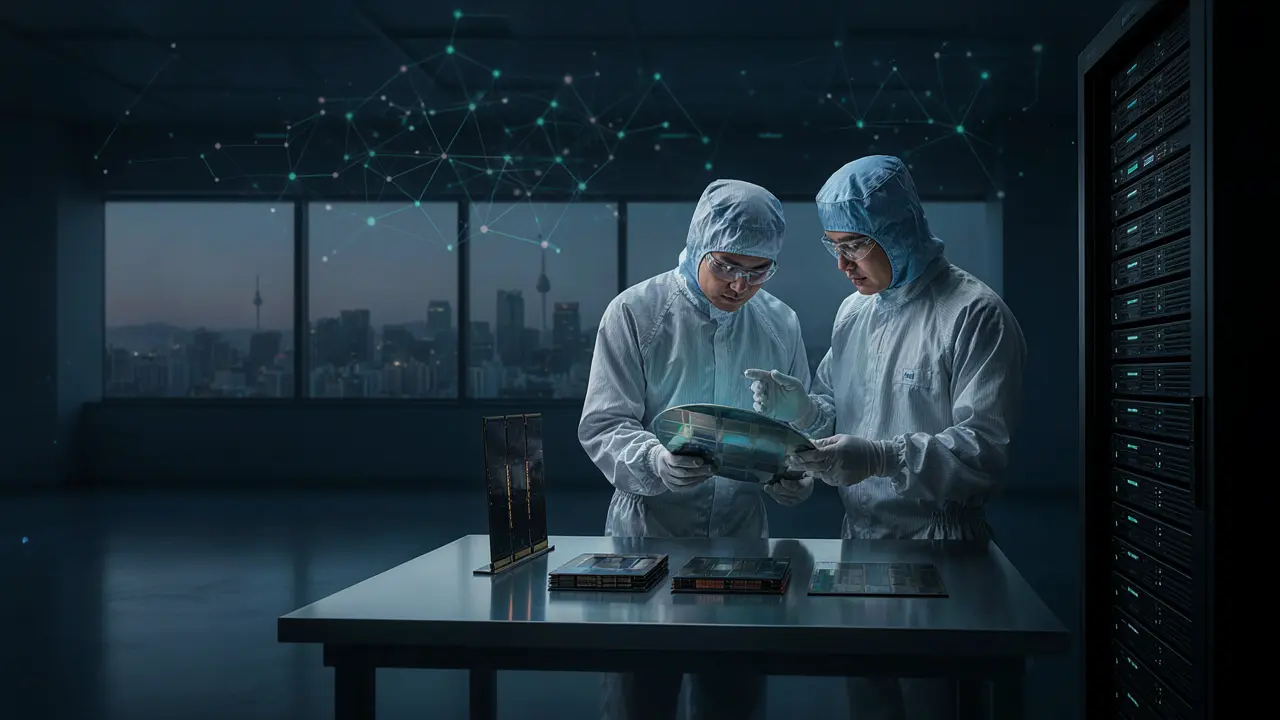
South Korean technology stocks are gaining renewed investor attention as strong demand for artificial intelligence infrastructure continues to reshape the global semiconductor industry. SK Hynix and Samsung Electronics are at the center of this movement, with both companies benefiting from expectations surrounding AI related chip demand.
The latest market movement highlights how rapidly artificial intelligence is influencing technology companies and financial markets. As AI systems become more sophisticated, demand for advanced memory, high performance computing, and data center infrastructure continues to grow.
Consequently, investors are paying closer attention to semiconductor manufacturers that can benefit from the expansion of AI infrastructure. The performance of SK Hynix and Samsung therefore provides an important indication of how the AI boom is affecting South Korea’s technology sector.
SK Hynix Benefits From Advanced Memory Demand
SK Hynix has become an important supplier in the rapidly expanding market for high bandwidth memory. These specialized memory products are essential for advanced AI processors because they allow large amounts of data to move quickly between computing components.
As AI models become larger and more complex, computing systems require increasingly powerful memory solutions. Therefore, demand for high bandwidth memory has become an important growth driver for semiconductor manufacturers.
SK Hynix’s position in this market has attracted significant attention from investors. Moreover, continued investment in AI data centers could support demand for advanced memory products over the longer term.
These developments are closely connected with current AI trends and insights, which show how specialized hardware is becoming just as important as software innovation in the development of modern AI systems.
Samsung Strengthens Its AI Semiconductor Position
Samsung Electronics is also benefiting from the broader expansion of AI infrastructure. The company operates across several areas of the technology ecosystem, including memory chips, semiconductor manufacturing, and consumer electronics.
Its large scale semiconductor operations give Samsung the opportunity to benefit from increasing demand across multiple technology markets. Furthermore, investments in advanced manufacturing and memory technologies could strengthen its position as AI adoption expands.
At the same time, competition within the semiconductor industry remains intense. Companies need to continuously improve production efficiency, technology capabilities, and product performance to remain competitive.
Therefore, Samsung’s future performance will depend not only on rising AI demand but also on its ability to execute its semiconductor strategy effectively.
AI Infrastructure Drives Semiconductor Growth
The growth of artificial intelligence requires enormous computing resources. Data centers need powerful processors, advanced memory, networking equipment, and increasingly sophisticated cooling and energy systems.
As a result, AI infrastructure has become a major source of demand throughout the semiconductor ecosystem. Companies supplying components used in AI servers can potentially benefit as technology firms and cloud providers expand their computing capacity.
Machine learning advancements are also contributing to this trend. Modern machine learning systems process increasingly large datasets and require substantial computing power during both training and operation.
Consequently, semiconductor innovation is becoming a critical part of the wider AI development cycle.
Generative AI Creates New Hardware Demand
The rapid growth of generative AI has further increased interest in advanced computing infrastructure. Generative AI applications can process text, images, video, audio, and other forms of complex information, requiring significant computational resources.
Technology companies are therefore investing heavily in data centers capable of supporting these workloads. In turn, this investment creates opportunities for semiconductor manufacturers that provide the memory and processing technologies required by these systems.
Generative AI developments are also expanding beyond consumer applications. Businesses are increasingly exploring AI for software development, customer service, research, financial analysis, content creation, and operational automation.
This broader adoption could sustain demand for computing infrastructure as organizations integrate AI into everyday workflows.
South Korea’s Role in the Global AI Supply Chain
South Korea plays an important role in the global semiconductor industry. Its technology companies have developed extensive capabilities across memory production, electronics manufacturing, and advanced chip development.
Therefore, rising demand for AI hardware could have implications beyond individual companies. Strong semiconductor exports can contribute to broader economic activity while reinforcing South Korea’s position within the global technology supply chain.
However, the industry remains exposed to cyclical demand, global trade conditions, capital expenditure trends, and competition from international manufacturers.
Investors consequently need to consider the broader market environment rather than viewing AI demand as the only factor influencing semiconductor performance.
Technology Innovation Continues to Accelerate
The semiconductor industry is evolving alongside broader technology transformation. Automation and future tech are encouraging manufacturers to improve production processes, reduce inefficiencies, and increase the sophistication of semiconductor facilities.
Meanwhile, artificial intelligence itself is being used to improve chip design, manufacturing processes, predictive maintenance, and quality control.
AI industry updates increasingly demonstrate that the relationship between AI software and hardware is becoming more interconnected. Better algorithms require more capable hardware, while better hardware enables increasingly sophisticated AI applications.
This creates a reinforcing cycle of innovation across the technology sector.
Investors Watch the Next Stage of AI Growth
For investors, the latest movement in South Korean technology stocks demonstrates the growing importance of AI related semiconductor demand. However, market expectations can change quickly.
Valuations, global interest rates, semiconductor pricing, supply conditions, corporate earnings, and technology investment cycles can all influence stock performance.
Therefore, investors should distinguish between short term market enthusiasm and sustainable long term growth. Companies with strong technology capabilities and diversified business models may be better positioned to navigate changing market conditions.
Future of AI research could also influence the next generation of hardware requirements. Advances in model efficiency, specialized processors, robotics, autonomous systems, and AI agents may create new opportunities across the semiconductor ecosystem.
What Businesses Can Learn From the AI Boom
The rise of AI focused semiconductor demand offers an important lesson for businesses outside the technology sector as well. Artificial intelligence is increasingly influencing infrastructure, workforce requirements, investment decisions, and competitive strategies.
Organizations should therefore monitor AI developments carefully and identify where new technologies can create practical value. At the same time, businesses need to consider data security, implementation costs, workforce capabilities, and responsible technology use.
HR trends and insights are becoming relevant because organizations adopting AI will require employees who can work effectively with advanced digital tools. Similarly, leadership development insights can help managers guide teams through technological change.
Valuable Insights for Technology Leaders
The latest performance of South Korean technology stocks highlights how deeply artificial intelligence is influencing the global technology economy. SK Hynix and Samsung are particularly important because their semiconductor capabilities place them close to the expanding demand for AI infrastructure.
For technology leaders, the key opportunity is to look beyond short term enthusiasm and understand the structural changes taking place across computing, memory, data centers, and AI applications.
Companies that invest strategically in infrastructure, workforce capabilities, data, and responsible AI adoption can be better prepared for the next phase of technological growth.
Stay informed with AITechInfoPro for practical AI trends and insights covering emerging technologies, semiconductor innovation, and digital transformation.
Reach out to AITechInfoPro for valuable perspectives that can help businesses understand and navigate the rapidly evolving AI landscape.
Source – economictimes.indiatimes